
Why It Is Called Surrogate's Court
New York gives its probate court an old name. Surrogate's Court is established in every county to hear cases about the affairs of people who have died. That includes probate of wills, administration of estates, and trust proceedings. In Dutchess County, the Surrogate's Court shares the courthouse at 10 Market Street with Supreme and County Court. Surrogate Michael G. Hayes, AJSC, presides. The term surrogate comes from the judge acting in place of the deceased to see that an estate is settled fairly.
The court also shares some jurisdiction with other courts. Family, Supreme, and Surrogate's Courts have concurrent jurisdiction over guardianships of infants. Family and Surrogate's Courts share adoption jurisdiction. For a related family matter, see Dutchess County court records.
Dutchess County Surrogate's Court
10 Market Street
Poughkeepsie, NY 12601
845-431-1720
Mon-Fri 9:00 a.m.-5:00 p.m.
Searching Dutchess Probate Records
WebSurrogate is the official portal for Surrogate's Court filings. It is listed as a case-search application on the NY Courts e-Courts page. A user can search by county, file number, decedent or party name, and proceeding type. Public access excludes sealed adoption, guardianship, and minor or confidential matters. For records not online, the chief clerk at the courthouse can search the files.
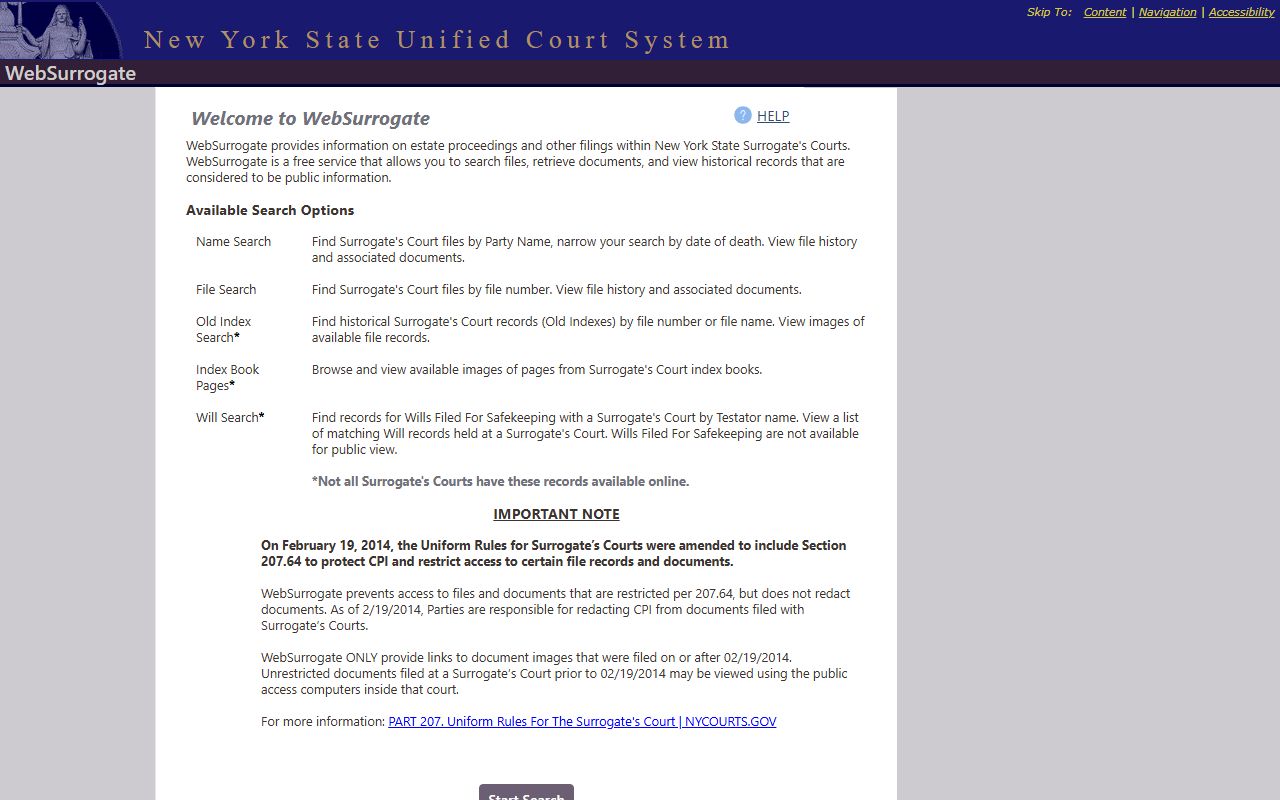
The WebSurrogate portal lets the public search Surrogate's Court filings for probate and estate matters that are not sealed.
| Field | Type | Notes |
|---|---|---|
| County | Dropdown | Select Dutchess. |
| File Number | Text | Surrogate file number if known. |
| Decedent or Party Name | Text | Last and first name, or estate name. |
| Date Range | Date | Filing or death date filters where offered. |
| Proceeding Type | Dropdown | Probate, administration, accounting, guardianship. |
How Probate Works in Dutchess County
Probate is the court-supervised process of settling an estate. It confirms a will, names a person to manage the estate, and oversees the payment of debts and the transfer of property. The path below is the general order in Dutchess Surrogate's Court. A contested matter can add objections, discovery, and hearings.
- Determine whether the decedent left a will.
- Decide if full probate or administration applies, or whether the small estate process fits.
- Prepare the petition and Surrogate forms with the death certificate, will, heirs, asset estimate, and fiduciary details.
- File with Dutchess Surrogate's Court and pay the filing fee.
- Obtain waivers and consents from heirs, or serve a citation.
- The court reviews the proof, admits the will if valid, and issues letters.
- The fiduciary gathers assets, pays debts and taxes, accounts, and distributes the estate.
Small Estates and Voluntary Administration
Not every estate needs full probate. New York has a simpler small estate process called voluntary administration. SCPA Article 13 governs the settlement of small estates without full administration. SCPA § 1301 defines the terms and the monetary threshold for a small estate. The threshold can change, so confirm the current figure in the statute before filing.
The voluntary administrator gathers and distributes the qualifying assets under court oversight, with far less paperwork than full probate. NY Courts publishes self-help resources for these filings. The When Someone Dies section walks families through the basic steps and links the Surrogate forms.
What a Probate File Contains
A Dutchess probate file holds the core documents of an estate. The exact set depends on whether the case is full probate, administration, or a small estate. Most files share a common backbone of petition, will, and fiduciary papers.
- Decedent name, domicile, and date of death.
- Petition for probate or administration.
- Original will and any codicils, where filed.
- Waivers, consents, or citations to heirs and distributees.
- Fiduciary name and letters testamentary or of administration.
- Bond information, where required.
- Inventory, accounting, and the final decree.
- Testator
- The person who made the will.
- Executor
- The person named in a will to manage and settle the estate.
- Administrator
- The person the court appoints to settle an estate when there is no will.
- Intestate
- Dying without a valid will; state law then decides who inherits.
- Letters
- The court document that gives a fiduciary legal authority to act.
- Guardianship
- A court arrangement for someone who cannot manage their own affairs, such as a minor.
Surrogate's Court Filing Fees
Surrogate filing fees are set on a statewide schedule and usually scale with the size of the estate. Confirm the current fee with the chief clerk or the NY Courts Surrogate fee schedule before filing. The County Clerk handles certified copies of certain recorded items, and copy fees follow the county schedule.
| Item | Fee |
|---|---|
| Surrogate probate or administration filing | Set by estate value on the NY Courts Surrogate schedule |
| Clerk-prepared certified copy (County Clerk) | $1.25 per page, $5 minimum |
| Client-prepared copy (County Clerk) | $0.65 per page, $5.20 minimum |
| Exemplified copy | $15, includes certified copy fee |
| Search fee (per name, per two years) | $5 |
Note: the Surrogate filing fee is set by the value of the estate, so the exact amount depends on the assets reported in the petition.
Guardianships and Trusts
Surrogate's Court does more than probate wills. It handles trust proceedings and shares jurisdiction over guardianships of infants with Supreme and Family Court. A guardianship case names a person to manage the affairs or property of someone who cannot do so, often a minor who inherited assets. Trust matters cover the creation, oversight, and accounting of trusts tied to an estate.
These cases follow the same court but use different forms and petitions than a basic probate. Where a guardianship involves a minor, the file carries added confidentiality. A family unsure which court fits a guardianship question can ask the chief clerk, since the answer depends on the age and situation of the person who needs protection.
Restricted Estate and Adoption Records
Not all Surrogate matters are open. Adoption records are highly restricted, and release generally needs statutory authorization or a court order. Guardianship and minor matters carry confidentiality. Mental-hygiene-related proceedings are limited. The public side of WebSurrogate reflects these limits and will not show sealed or confidential filings.
A person with a legal interest in a closed file, such as a fiduciary or an heir, may have access the general public does not. When in doubt, ask the chief clerk what is open and what needs a court order. For agency records outside the courts, see Dutchess County public records.